Uncategorized

The Gangrene Effect

Community connectedness is not just about warm fuzzy tales of civic triumph. In measurable and well-documented ways, social capital makes an enormous difference in our lives. […] social capital makes us smarter, healthier, safer, richer, and better able to govern a just and stable democracy.”

—Robert D. Putnam, Bowling Alone  (2000)


Imagine this: You look down at your left forearm. There’s a small patch of what looks like dirt. You go to wipe it off, but instead of coming clean, the skin begins to bleed—not a lot, not painfully, but it’s clearly not normal. You try again the next day. It bleeds again. So you stop touching it. A week goes by. Then a month. Then five years. Now the red patch has expanded until your entire forearm is inflamed, bleeding—unrecognizable.

Sounds absurd, right? Why would anyone leave a minor wound to fester for years? And yet people ignore other obvious signs of dysfunction everyday. 

I see the equivalent of this in my dental practice all the time: “My gums only bleed when I floss—so I just don’t floss.” And when asked how long it’s been happening, the answer is often: “Oh, I don’t know—a few years, probably.”

Bleeding gums are the dental version of that red patch on your arm: a warning sign we normalize. We tell ourselves it’s fine. We stop poking it. We move on. 

But normalized dysfunction is still dysfunction. And bleeding gums are just one example of a much deeper human tendency to discount what we can’t easily see.

It’s why we ignore the quiet decay of underfunded schools in low-income neighborhoods. It’s why people sleeping in doorways become invisible after enough commutes. It’s how overdoses become statistics.

There’s a more dangerous form of collective denial hiding beneath our social systems. Around the world, governments routinely neglect individuals deemed too broken, too complex, or too costly to help. We label them “unrehabbable” or “noncompliant.” We subtly justify abandoning them—socially, economically, even medically. 


In political science, there’s a term called “utilitarian distributive justice.” It suggests that government resources should be distributed to maximize society’s overall utility. In fact, it suggests there’s an ethical imperative for such efficiency—an appealing idea when viewed through a cost-benefit lens.

But somewhere along the way, that  principle was swallowed whole by market logic. We stopped asking whether society was healthy and started asking whether it was efficient

We began rationing compassion.

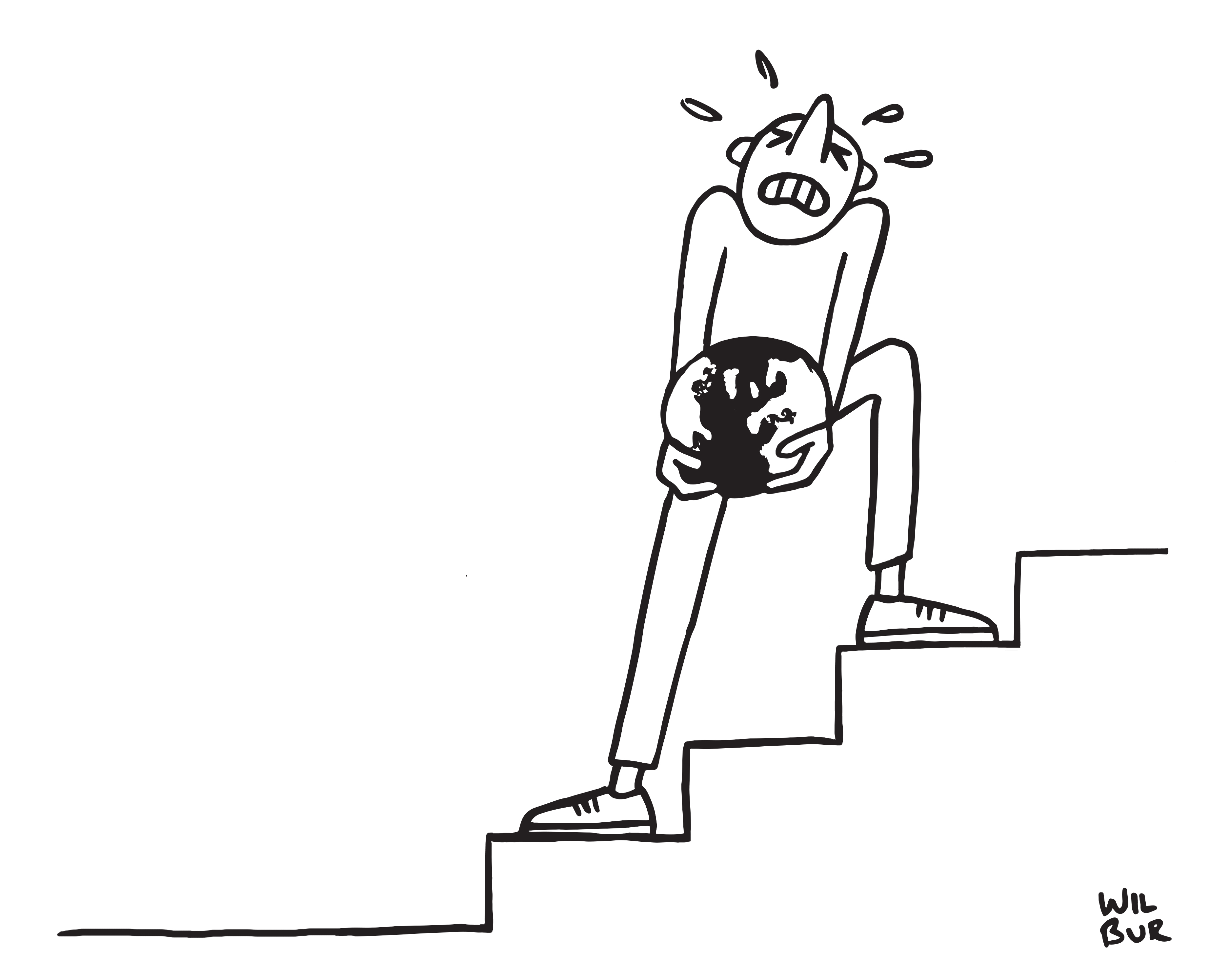
Writing off marginalized populations to “optimize” the majority is like ignoring a gangrenous toe because the rest of the body is functioning. But the body doesn’t work that way. And neither does a society.

This is what I call the Gangrene Effect of public policy: the idea that certain people or problems are too small, too far gone, or too expensive to treat. It’s what happens when we pretend the damage won’t spread. 

But gangrene always spreads. What could have been saved with early intervention turns into a full-blown crisis—for the whole body.

Your healthy muscles can’t run a marathon if your lungs are suffocating. You can’t cure cancer or raise children if your appendix has burst. You can’t innovate when you’re hemorrhaging from a wound that everyone pretends isn’t there.

The body acts as a cohesive whole first, and a collection of organ systems second. Society must do the same.

Of course, critics will say, “There’s no such thing as ‘unlimited resources.’ Every body still needs food. It needs rest. It needs to keep moving enough to survive while it heals.” And they’re not wrong. 

Priorities matter. But ignoring the damage doesn’t preserve the system—it quietly undermines it.

This isn’t just a policy failure. It’s a psychological blind spot.

Human psychology struggles to acknowledge what it cannot easily see. No one ignores a festering, bleeding forearm in front of them. But it’s easy to dismiss the “occasional” bleeding gums. And even easier—almost expected—to ignore society’s “gangrenous toe.”

Out of sight, out of mind.

But invisible damage is still real damage—seen or unseen, it’s still there. We rationalize dysfunction until it becomes “normal”, until the red, swollen patch has taken over the whole arm—the whole society.


And yes, this entire metaphor rests on a deeper belief: that all of the body — all lives in society — are of equal worth, equal importance, equal necessity. That’s not always easy to accept. But the moment we start ranking whose pain deserves help, we trade society’s health for hierarchy. And hierarchy is not health.

So the next time you read a budget or hear someone dismissed as a “lost cause” or a program cut because it’s “not cost-effective,”

Pause.

Ask: “What would happen if this were a limb on my own body? What if it were my own child? My neighbor? What if it were me?”

And when you hear someone talk about “pulling your weight,” ask yourself: “Which part of the body is choosing to ignore the infection? Which part has the power to act—but doesn’t? Who’s benefitting here? What is this really about?”

This isn’t just about pity. It’s about participation.

People stuck in cycles of poverty, addiction, and violence don’t need our judgment—they need early intervention, investment, and connection. They don’t need to be “fixed” so they can be “productive.” They need to be valued because they’re human. They are part of our body. Part of our community. And we all suffer when they are left to rot.

Gangrene doesn’t stop when we ignore it. It spreads—until there’s nothing left.


“Well, once you have the premise that every human life is of equal value — I mean, that directs a lot of what you do — both your money and your efforts, and the people you attract, and all sorts of things involved in that.”

— Warren Buffett, Inside Bill’s Brain: Decoding Bill Gates, Part 2 (2019)
Standard
Uncategorized

If We Were Like Clouds

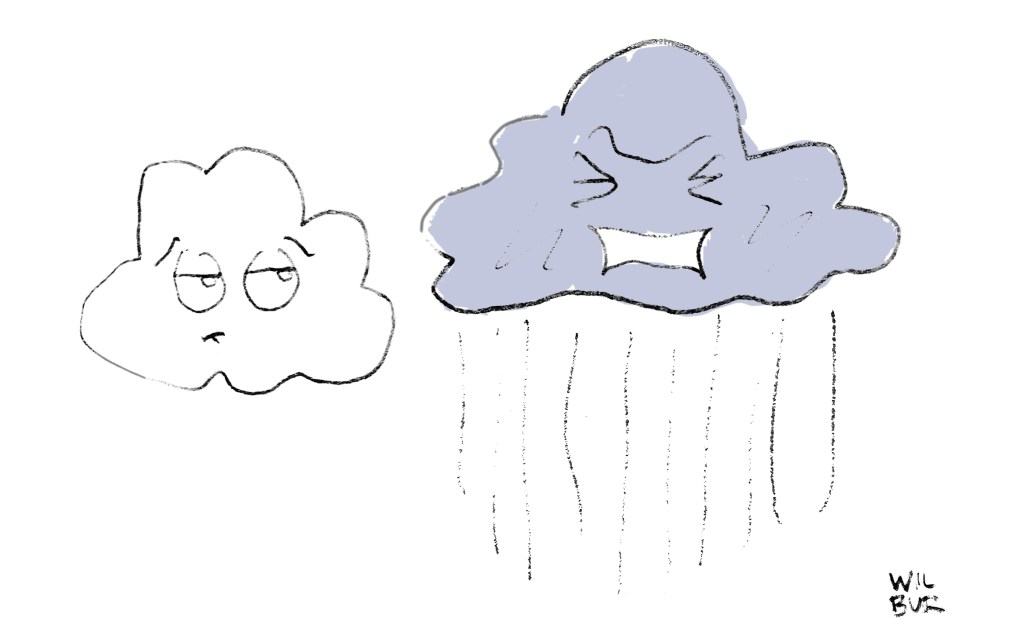
Do clouds have bad days? Do you think a cloud ever wakes up, bursting at the seams, downpour-ready, when a sudden weather front prevents it? Are clear blue skies a cloud tragedy or a much needed respite? Do they have things they need to get done? Do they have deadlines?

Created through the (very official sounding) process of adiabatic cooling, clouds form from a speck of dust.1 As they grow they can become tiny wisps of cotton-candy or large torturous storms. They can bring peaceful shade or apocalyptic destruction. They are infinite in potential shape, size, and formation yet can be placed into a few broad categories.2 Whether insulating or reflecting, heating or cooling, shading or pouring, the life of a cloud is defined by the unique conditions of its birth and the interaction with its immediate surroundings. Sound familiar?

We humans share a lot with our ‘inanimate’ cousins (who are as alive and connected as any of us). Like clouds, we each play a role as one part of a greater whole. And like clouds, we play this role perfectly every minute of every day. The difference is our inward analysis and perception of how things are going. It’s the illusion of “progress” that makes us feel like we’re on the “wrong path,” “behind,” or “failing.” It is our judgement of the situation, not the situation itself, which causes dissatisfaction. Our arbitrary timelines, deadlines, and goals are part of our motivation machinery, but they do not define our purpose (which often goes hidden or unnoticed, like clouds unaware of the vital roles they play).

True, clouds have a distinct advantage in accepting their existence as is—accepting life with a stoicism afforded only by the most inanimate of nature’s living body. But we can still learn a lot from clouds, created and destroyed in harmonious balance with the rest of nature. Are we really any different?


Related essay: “If We Were Like Trees” (2017)

___

  1. “The Importance of Understanding Clouds,” NASA Fact Sheets, National Aeronautics and Space Administration, http://www.nasa.gov, 2005. (Source)
  2. Jin-Yi Yu, “Chapter 6: Cloud Development and Forms,” Microsoft Power Point. Earth System Science 5: University of California, Irvine. (Source)
Standard
Uncategorized

Humanity’s Kitchen

Why does incapacitating mental illness exist? Why would nature consistently produce people born with debilitating health problems? Is nature so cruel and unfair that it curses some people while blessing others? Perhaps. But perhaps there’s an alternative interpretation.

We humans are made up of a collection of traits.* Contrary to early scientific thought, we now know that these traits are rarely useful or dysfunctional on their own. When things go wrong, it’s less about dysfunctional traits and more about dysfunctional combinations. A useful analogy is to think of human characteristics as ingredients in a kitchen. Some combinations taste foul and others sublime; some are subtle, and others can easily overpower. And we humans are the final dishes.

The trouble with this model is that at Bistro Homo Sapien the menu is enormous. Humanity’s kitchen must stock such an immense array of ingredients that inevitably there are going to be some unpleasant combinations.

Take for example people who have difficulty filtering out the mundane elements of their surroundings (latent inhibition). These people struggle to block out irrelevant details, and as you might imagine, this can be hugely problematic. In fact, this dysfunction is associated with an increased risk of schizophrenia—but not always.

For some people, a difficulty to filter combines with another trait—high IQ—to produce a high-functioning creativity. Rather than being overwhelmed by extraneous inputs, these creatives can channel their access to additional information in positive ways. Dysfunction, then, is a matter of compatibility. (Oversimplifying: Low Latent Inhibition × Low IQ = Incompatible Schizophrenia; Low Latent Inhibition × High IQ = Compatible Creativity)

So perhaps human biology is unfair. Although, it may be helpful to remember that, “Nature optimizes for the whole, not for the individual.”2 The mechanism that allows some trait combinations to flourish requires others to falter. In this light, even debilitating mental illness can be seen as a positive—an example of the rich, robust, and beautiful diversity of our species.


* “Traits” is used here as a general, catch-all for observable human characteristics. A person could be described as “naturally shy,” for example. In a more scientific description, we could use phenotype; however, this genetic term often fails to reflect the combination of life-experience, genetic predisposition, and environmental factors that combine to create what most of us colloquially refer to as human traits.

___

  1. Carson, S.H., et al., 2003. “Decreased latent inhibition is associated with increased creative achievement in high-functioning individuals.” Journal of personality and social psychology85(3), 2003. (Source)
  2. Ray, Dalio, Principles: Life and Work. New York: Simon and Schuster, 2017. (Book)
Standard
The Global Schoolhouse

Globalization University: Time to Pack Our Bags

moving up?

People can have several layers of loyalty. You can be loyal to your family and your community and your nation. So why can’t you also be loyal to humankind as a whole? Of course, there are occasions when it becomes difficult—what to put first—but, you know, life is difficult; handle it.

—Yuval Noah Harari, “Nationalism vs. Globalism: The New Political Divide” (2017)

The world is changing. It’s moving from a patchwork of individual nations to a collective mix of nations, corporations, and power brokers. It’s moving from nationalization to globalization. People may argue that this shift has been going on for decades, which it has, but now the excitement has worn off and the reality of change—that daunting task that underlies any big move—is setting in. We’re graduating from The Global Schoolhouse of the 20th Century and enrolling in the Globalization University of the 21st.

For some this transition is fraught with anxiety. Others see it as an exciting time full of opportunity and a better future. Regardless of our feelings, the actual transition can be painful. There are costs to change.

Think of the last time you moved: There was the time-consuming packing process, where we boxed everything up; the moving process, which left our backs sore and our muscles achy; followed by the unpacking process, which felt like deja vu after packing in the first place. Where do the boxes go? Where does the stuff inside the boxes go? Why do we have so much crap?! But possibly the hardest part of the whole moving process is the initial step: We must first decide what stays and what goes.

From my vantage point, this is where humanity finds itself today. We are trying to determine what to keep and what to throw out. This is an extremely difficult task for a world where we’ve accumulated enormous amounts of “stuff”—various different languages, religions, and cultural identities; unique customs, clothing, and holidays; separate currencies, laws, and governing bodies; and often differing political wills, motivations, and priorities. A global world requires that some of these historical accumulations are thrown out, some are kept, and most (if not all) are restructured, repurposed, and relocated.

The world is moving house. We’re going away to college. We’re moving into a crowded dorm with all sorts of people from all around the world. This is Globalization University, where navigating our own national heritage is just as awkward and messy as 18-year-old co-eds trying to “find themselves” at a Freshman kegger.

It is certainly an exciting time to be alive, but that doesn’t mean that it’s an easy time. We’re merely in the packing process—just getting started—and already there is global backlash. Much of this outcry comes from a combination of what psychologists call the endowment effect and loss aversion. Respectively, we put more value on things that are ours simply because they’re ours (endowment effect). And consequently, we perceive a more significant loss when our stuff is taken away. This includes ownership of concrete entities like factories and jobs becoming “redundant,” as well as abstract ownership like specific ways of life or cultural identity. When our way is in jeopardy, emotions run high, objections flow freely, and we fight like hell not to avoid loss.

It’s important to remember, however, that while packing and moving are difficult, we’re not alone. When we show up to Globalization University on move-in day and look around at all the other students unpacking in front of our dorm, we should remember that all those fresh faces went through the same process. They’re going through it now. Our global peers are struggling with this move too. Whatever nation we come from, global dorm life is something none of us have ever experienced. It’s not nations that solely cause globalization; technology stretches beyond political and geographic borders. We’re in this together (for better or for worse).

Harari, Yuval Noah. “Nationalism vs. Globalism: The New Political Divide.” TED. Feb. 2017. Lecture. (Source)

*This essay is a follow up to the series, “The Global Schoolhouse,” originally published on December 2016. You can read Part 1 here.

Standard
Uncategorized

The Cliff of Care

too muchImportance is the worst thing to put on art, comedy—creativity of any kind. […] If you think this is important, you’re screwed before you write the first word.
—Jerry Seinfeld, Comedians In Cars Getting Coffee with Lewis Black

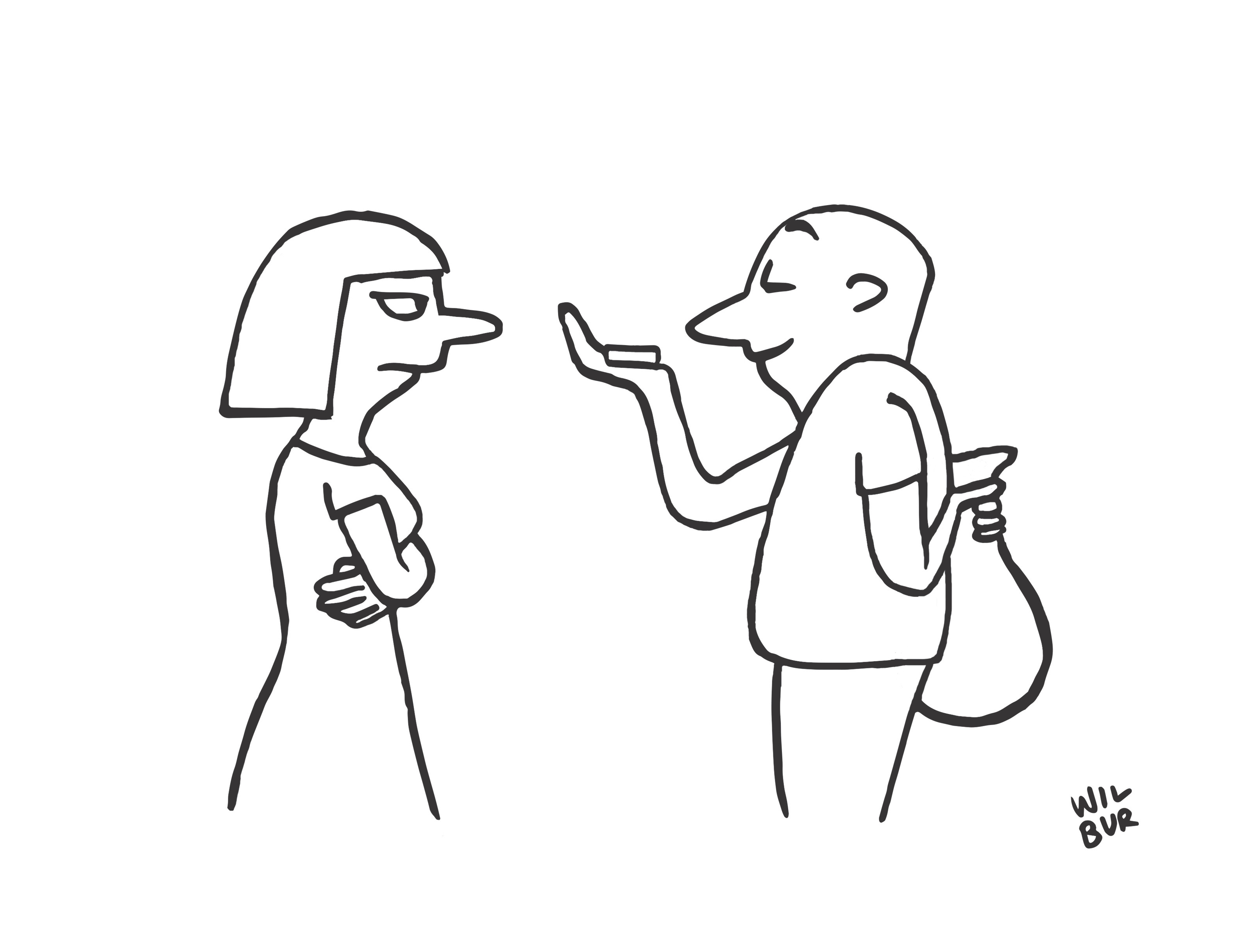
What is the difference between caring too much and not enough? Sometimes it’s just one last straw—one final incident that pushes us over the edge. We see this at our workplaces, contrasting an excited intern with the embattled veteran clocking in and out like a robot. We see it with new parents who trade fashion for durability. And we see it in politics when the news creates such a piercing noise that we simply go deaf to the din.

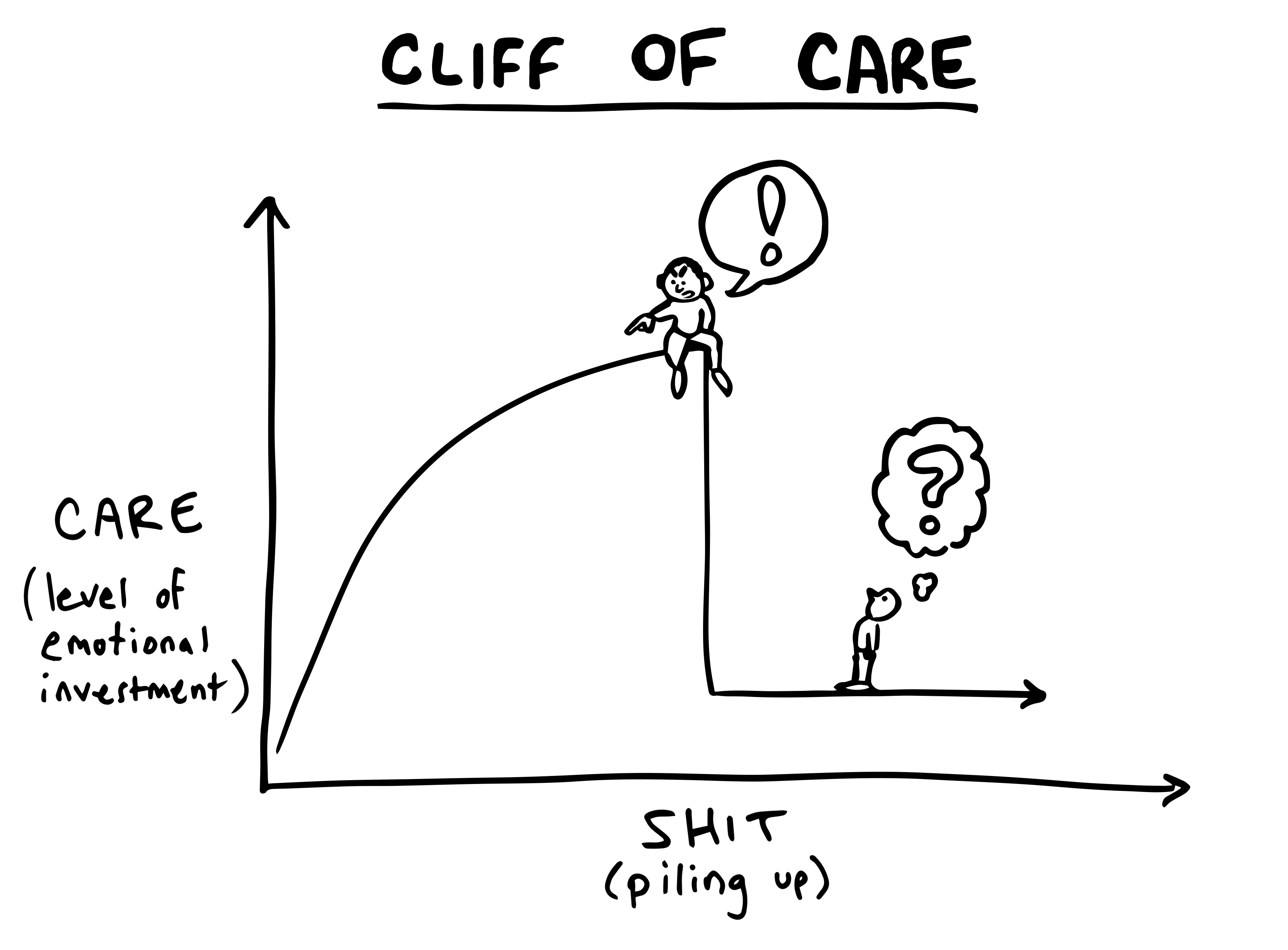
Like eating or drinking too much, our care has a breaking point. A gluttonous night out can force our stomach from too full to completely empty in an instant, and it is this momentary purge that exemplifies the Cliff of Care. With so many names—outrage fatigue, clarity, burnout, calm, apathy, patience—it can be difficult to know whether the valley beyond the cliff is a safe place to be. As with any journey, it depends on how we got there and our attitude along the way.

Once we reach the cliff’s edge, we can either walk off gracefully, landing softly on the ground below, or get pushed, kicking and screaming, breaking bones on the way down. This is the difference between coming to peace with our situation or becoming apathetic in our resentment. The graceful among us land on their feet through the power of perspective. These are the people who after battling illness, divorce, violence, bankruptcy, discrimination, and many other hardships, still find the positive in each challenge, putting them into perspective. They are calm and kind despite every reason not to be. And they serve as inspiration to “get over” whatever small annoyances we face in life.

Unfortunately, the less gracious cliff jumpers—the ones who bitterly or hopelessly give up the will to care—also exist. Fortunately, the Cliff of Care is not a standalone phenomenon. We may tumble off the cliff and become apathetic to the politics of our world but safely detached at work, no longer wrapping our self-worth in what our boss thinks. This is where awareness can be helpful. Just by knowing about the difference between being on the cliff and being in the valley can help us safely navigate our way.

Detaching emotionally is not something we can will ourselves to do (at least, not immediately). Stepping off the cliff allows us to leave behind our emotional baggage, but first it requires a gradual climb of frustration. This is why telling someone they need to just “get over it” rarely works. Seeing the cliff for what it is can make us come across as callous or cold-hearted when dealing with those who have not yet moved on. Brushing off their emotional concerns as unimportant is seen as dismissive. Rather than pushing them off the cliff to a painful, bitter landing, we must try to remember what it was like to be atop the cliff, empathize, and help guide them down safely.

Conversely, when we’re stranded on the peak of care, pulling our hair out, and wondering why no one else gives a shit, it is difficult to see our position for what it is. We don’t have the perspective. Holding on to what feels important can be blinding. Whether it’s the cleanliness of the kitchen, quarterly sales at work, or death of a loved one, not everyone is going to understand our level of care. And while intense care can motivate us to act, we shouldn’t expect others to follow. When we find ourselves in isolation in a sea of seeming apathy, it may be time for self-reflection. It is immodest to think that we are the only sane people in a world full of crazies.

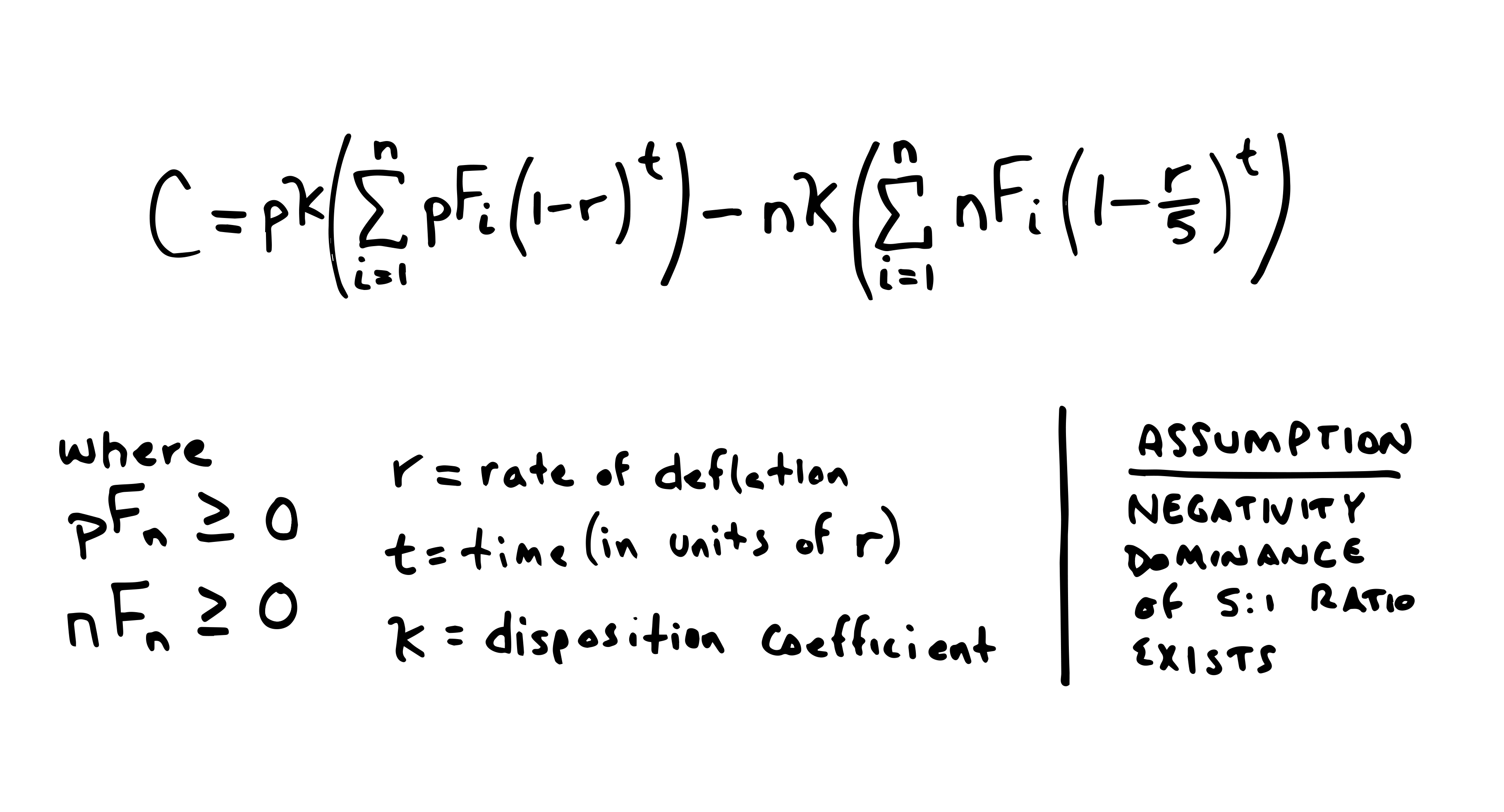
cliff of care_graph

Standard