Uncategorized

The Gangrene Effect

Community connectedness is not just about warm fuzzy tales of civic triumph. In measurable and well-documented ways, social capital makes an enormous difference in our lives. […] social capital makes us smarter, healthier, safer, richer, and better able to govern a just and stable democracy.”

—Robert D. Putnam, Bowling Alone  (2000)


Imagine this: You look down at your left forearm. There’s a small patch of what looks like dirt. You go to wipe it off, but instead of coming clean, the skin begins to bleed—not a lot, not painfully, but it’s clearly not normal. You try again the next day. It bleeds again. So you stop touching it. A week goes by. Then a month. Then five years. Now the red patch has expanded until your entire forearm is inflamed, bleeding—unrecognizable.

Sounds absurd, right? Why would anyone leave a minor wound to fester for years? And yet people ignore other obvious signs of dysfunction everyday. 

I see the equivalent of this in my dental practice all the time: “My gums only bleed when I floss—so I just don’t floss.” And when asked how long it’s been happening, the answer is often: “Oh, I don’t know—a few years, probably.”

Bleeding gums are the dental version of that red patch on your arm: a warning sign we normalize. We tell ourselves it’s fine. We stop poking it. We move on. 

But normalized dysfunction is still dysfunction. And bleeding gums are just one example of a much deeper human tendency to discount what we can’t easily see.

It’s why we ignore the quiet decay of underfunded schools in low-income neighborhoods. It’s why people sleeping in doorways become invisible after enough commutes. It’s how overdoses become statistics.

There’s a more dangerous form of collective denial hiding beneath our social systems. Around the world, governments routinely neglect individuals deemed too broken, too complex, or too costly to help. We label them “unrehabbable” or “noncompliant.” We subtly justify abandoning them—socially, economically, even medically. 


In political science, there’s a term called “utilitarian distributive justice.” It suggests that government resources should be distributed to maximize society’s overall utility. In fact, it suggests there’s an ethical imperative for such efficiency—an appealing idea when viewed through a cost-benefit lens.

But somewhere along the way, that  principle was swallowed whole by market logic. We stopped asking whether society was healthy and started asking whether it was efficient

We began rationing compassion.

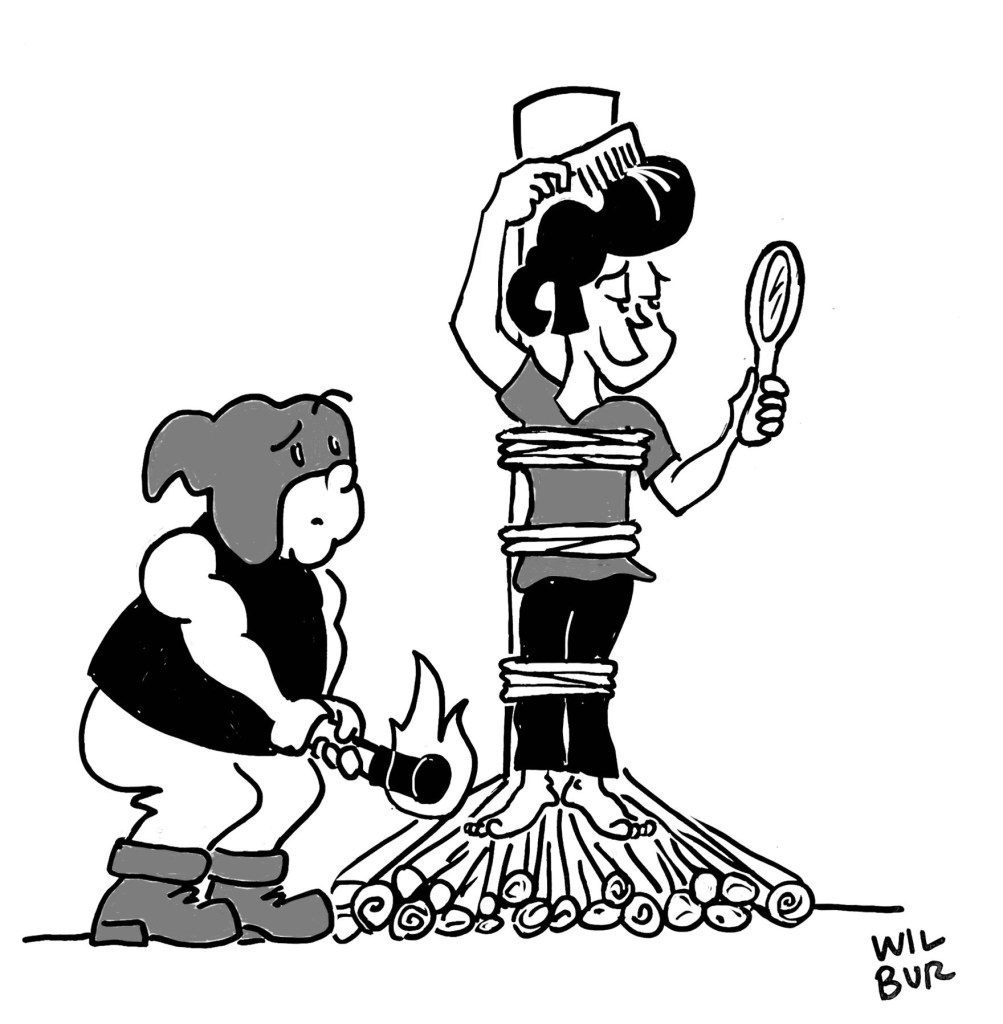
Writing off marginalized populations to “optimize” the majority is like ignoring a gangrenous toe because the rest of the body is functioning. But the body doesn’t work that way. And neither does a society.

This is what I call the Gangrene Effect of public policy: the idea that certain people or problems are too small, too far gone, or too expensive to treat. It’s what happens when we pretend the damage won’t spread. 

But gangrene always spreads. What could have been saved with early intervention turns into a full-blown crisis—for the whole body.

Your healthy muscles can’t run a marathon if your lungs are suffocating. You can’t cure cancer or raise children if your appendix has burst. You can’t innovate when you’re hemorrhaging from a wound that everyone pretends isn’t there.

The body acts as a cohesive whole first, and a collection of organ systems second. Society must do the same.

Of course, critics will say, “There’s no such thing as ‘unlimited resources.’ Every body still needs food. It needs rest. It needs to keep moving enough to survive while it heals.” And they’re not wrong. 

Priorities matter. But ignoring the damage doesn’t preserve the system—it quietly undermines it.

This isn’t just a policy failure. It’s a psychological blind spot.

Human psychology struggles to acknowledge what it cannot easily see. No one ignores a festering, bleeding forearm in front of them. But it’s easy to dismiss the “occasional” bleeding gums. And even easier—almost expected—to ignore society’s “gangrenous toe.”

Out of sight, out of mind.

But invisible damage is still real damage—seen or unseen, it’s still there. We rationalize dysfunction until it becomes “normal”, until the red, swollen patch has taken over the whole arm—the whole society.


And yes, this entire metaphor rests on a deeper belief: that all of the body — all lives in society — are of equal worth, equal importance, equal necessity. That’s not always easy to accept. But the moment we start ranking whose pain deserves help, we trade society’s health for hierarchy. And hierarchy is not health.

So the next time you read a budget or hear someone dismissed as a “lost cause” or a program cut because it’s “not cost-effective,”

Pause.

Ask: “What would happen if this were a limb on my own body? What if it were my own child? My neighbor? What if it were me?”

And when you hear someone talk about “pulling your weight,” ask yourself: “Which part of the body is choosing to ignore the infection? Which part has the power to act—but doesn’t? Who’s benefitting here? What is this really about?”

This isn’t just about pity. It’s about participation.

People stuck in cycles of poverty, addiction, and violence don’t need our judgment—they need early intervention, investment, and connection. They don’t need to be “fixed” so they can be “productive.” They need to be valued because they’re human. They are part of our body. Part of our community. And we all suffer when they are left to rot.

Gangrene doesn’t stop when we ignore it. It spreads—until there’s nothing left.


“Well, once you have the premise that every human life is of equal value — I mean, that directs a lot of what you do — both your money and your efforts, and the people you attract, and all sorts of things involved in that.”

— Warren Buffett, Inside Bill’s Brain: Decoding Bill Gates, Part 2 (2019)
Standard
Uncategorized

If We Were Like Clouds

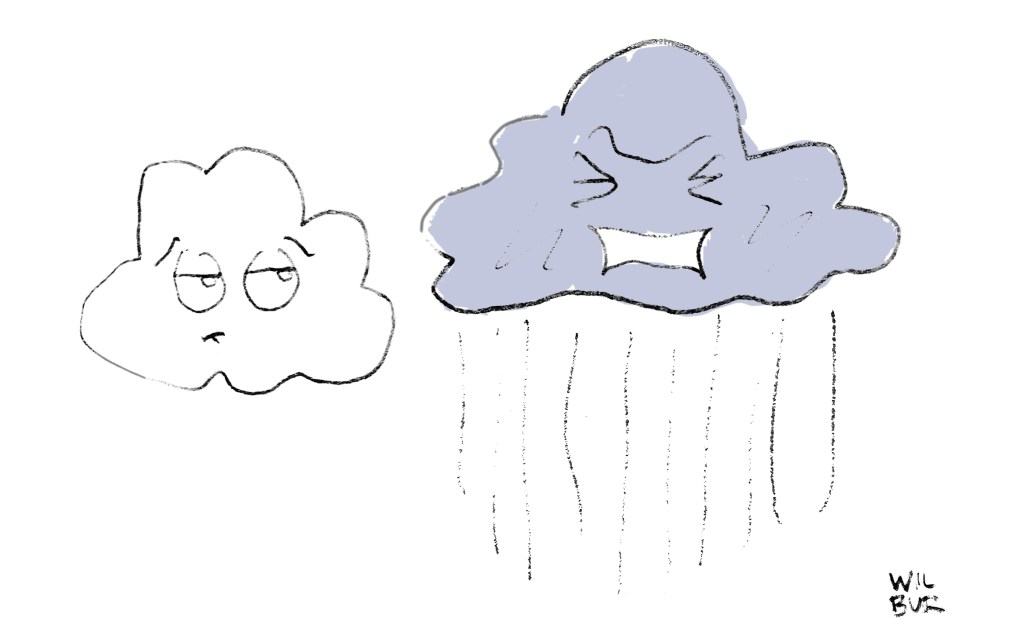
Do clouds have bad days? Do you think a cloud ever wakes up, bursting at the seams, downpour-ready, when a sudden weather front prevents it? Are clear blue skies a cloud tragedy or a much needed respite? Do they have things they need to get done? Do they have deadlines?

Created through the (very official sounding) process of adiabatic cooling, clouds form from a speck of dust.1 As they grow they can become tiny wisps of cotton-candy or large torturous storms. They can bring peaceful shade or apocalyptic destruction. They are infinite in potential shape, size, and formation yet can be placed into a few broad categories.2 Whether insulating or reflecting, heating or cooling, shading or pouring, the life of a cloud is defined by the unique conditions of its birth and the interaction with its immediate surroundings. Sound familiar?

We humans share a lot with our ‘inanimate’ cousins (who are as alive and connected as any of us). Like clouds, we each play a role as one part of a greater whole. And like clouds, we play this role perfectly every minute of every day. The difference is our inward analysis and perception of how things are going. It’s the illusion of “progress” that makes us feel like we’re on the “wrong path,” “behind,” or “failing.” It is our judgement of the situation, not the situation itself, which causes dissatisfaction. Our arbitrary timelines, deadlines, and goals are part of our motivation machinery, but they do not define our purpose (which often goes hidden or unnoticed, like clouds unaware of the vital roles they play).

True, clouds have a distinct advantage in accepting their existence as is—accepting life with a stoicism afforded only by the most inanimate of nature’s living body. But we can still learn a lot from clouds, created and destroyed in harmonious balance with the rest of nature. Are we really any different?


Related essay: “If We Were Like Trees” (2017)

___

  1. “The Importance of Understanding Clouds,” NASA Fact Sheets, National Aeronautics and Space Administration, http://www.nasa.gov, 2005. (Source)
  2. Jin-Yi Yu, “Chapter 6: Cloud Development and Forms,” Microsoft Power Point. Earth System Science 5: University of California, Irvine. (Source)
Standard
Uncategorized

If We Were Like Trees

Tree TabooIf trees could read, would they? Or would the fact that books have been printed on mulched up tree guts for centuries be a barrier to literary exploration? And while books may last for years, what would trees think of magazines? As silly as personification is, this line of questioning leads us to the real topic of today’s discussion: If we were like trees, would we live our lives differently?

Most of who we are is invisible. Humans are visual creatures with as much as two-thirds of our brains associated with vision. We use this ability to observe our three dimensional world, yet there’s a fourth dimension—time—that makes up the majority of who we are. Our experiences, our long years of life—the more diverse these are, the larger we “grow.” But it can be difficult to sense the enormity of a large life.

If we were like trees, we could stand in awe of the expansive lives of one another. We could marvel at the large trunks and broad canopies of our elders. We could see one another—our branching, our scars, our history carved into the physical embodiment of our years.

As much as we try, the material world does not provide an accurate representations of who we are. The cars we drive, the clothes we wear, the jobs we have, the photos we post—these are poor substitutions for the real thing. Even our bodies don’t tell the whole story. Wrinkles, blemishes, thinning hair—these might give away our age, but to accurately tell our life story? Impossible.

Unable to directly observe the experiences of others, we settle for sensing the shape of a person’s life through indirect measures—their demeanor, their stories, their stuff. Material wealth is often (mistakenly) used as a proxy for life worth. If we were like trees—if our bodies were a physical representation of our experiences—there would be less need for ancillary metrics. Just by looking, we would see the complexity and worthiness of even the poorest among us.

Also, unlike humans who reach a mature size a fifth of the way into our lives, trees continually grow larger over time. And not only that, they actually accelerate their growth as they age, meaning older trees are better at being trees (i.e. removing and storing carbon dioxide from the atmosphere). Imagine a life where your years of “peak performance” are always ahead of you, a life where you’re always getting better.

As humans age, our bodies become frail, small, and insignificant. There is no visual representation of all that a person has accomplished, all the people they’ve influenced, loved, and touched. The vastness of their experience is easily overlooked and under-appreciated. Yet the lives of our aged population are like the trees—enormous amounts of time and energy to be marveled.

We must be careful not to under-appreciate our elders—those people we call parents, grandparents, or great grandparents. We may not be able to see the immensity of their time here on earth, but we should be able to sense the scale of their lives and what they provide us.

When an old tree dies in the woods, it falls to the ground. It lies there like a giant among new growth, leaving a large space for smaller trees to fill. It decomposes providing nutrients for the next generation. That’s the circle of life. And the larger a tree’s life—the larger, physically, that tree was—the more it provides after death. To quote Isaac Newton, “If I have seen further than others, it is by standing on the shoulders of giants.” Perhaps humans too can embody the grand scale of a long life. We cannot see it directly, but it is still there, like the massive size of a fallen tree.

Many of us fear death, because it represents the end. We are afraid of regret, afraid of not having done or experienced enough. But what if we were like trees? Perhaps death would be seen as just the beginning—our large lives giving back to the small, the young, the future.

Stephenson, Nathan, et al. “Rate of Tree Carbon Accumulation Increases Continuously with Tree Size.” Nature 507.7490 (2014): 90-93. (Source)

Standard
Business & Biology

The Noncompetitive Advantage

hunter_hunted

Have you ever been chased by a bear? Heart racing, adrenaline pumping, looking for the nearest tree to climb to avoid almost certain death? Yeah, me neither. And that fact—that lack of being chased or having natural predators or competition—is precisely why humans have such long lifespans, and why some companies dramatically outlive their peers.

For years, biologist have made the simple observations that “bigger animals live longer lives.” The idea is that the bigger an animal becomes the more efficient they become. It’s a fact of biology, which extends into the world of business, urban planning, and organizational ecology. As theoretical physicist, Geoffrey West, puts it, “This might also explain the drive for corporations to merge. Small may be beautiful but it is more efficient to be big.” As with all rules, however, there are exceptions. But before we discuss the anomalies, let’s examine our options for survival.

There are three main strategies for small animals, organizations, businesses, cities, or powerless individuals to survive in the world of Big: (1.) direct competition, (2.) indirect competition, and (3.) noncompetition.

Direct competition is the easiest to understand, but is also the least effective (lowest survival). This is like turning toward that grizzly we talked about earlier and fighting back. There’s a chance of survival, but it’s not great. And at what cost? In business, small companies that use this strategy are labeled sustaining entrants. They compete in an established market against powerful incumbents by making some improvement to mainstream products.

As Clayton Christensen noted when developing the theory of disruptive innovation back in 1995, in the case of “the disk drive industry, only 6% of sustaining entrants managed to succeed.” And this makes sense, right? To directly compete for high-end or mainstream customers in an established market is going to draw attention from much more established players who have the ability to either defend (kill us) or acquire (eat us). Either way, survival and longevity are limited.

Indirect competition is a different game. We can view this as the dog eating food scraps that have fallen from the dinner table. While direct competition between small, young entrants and large, established incumbents is inherently unfair, indirect competition serves customers that are of little interest to large incumbents. Young firms appeal to low-value customers by providing lower quality products outside the mainstream market. This type of business calls less attention to itself, because it serves customers that would be a “waste of time” to larger incumbents.

Noncompetition is the anomaly in our discussion. This strategy is exactly what it sounds like—not competing. It’s finding or creating a niche that insulates us from hazards and outside competition. In business, as you might have guessed, noncompetition is rare.

In biology, it’s extremely rare for small animals to live for long periods, but birds and bats seem to break all the rules when it comes to life expectancy. Despite being small and having rapid metabolic rates—both significant indicators of short lifespan—birds and bats live 3-3.5x longer than animals of a similar size. In a world where corporate life expectancy is decreasing, many in business would be happy with a three-fold increase in survival.

For birds and bats, it’s a matter of flying. They’ve taken themselves out of the terrestrial equation, out of reach of countless potential predators and hazards. They’ve developed a mechanism to explore the sky, a niche above us land-based creatures. Their competitive advantage is simply not competing. They just fly away.

When we look at businesses that have defied the odds of survival, our view turns east toward Japan, where a handful of companies are over 1,000 years old. Just as flying has insulated birds and bats from harm below, older Japanese companies benefit from insulation. They are often small, primarily serve Japanese markets, run on values beyond profit-at-all-costs, and operate in a culture where acquisitions and mergers are avoided (compared to the West’s seeming love of M&As). Thousand-year-old Japanese enterprises are much different than the S&P 500, like the difference between earth and sky or mammals and birds.

Google, Amazon, Apple—These are the big game animals, the predators, the bears chasing us up a tree. Perhaps we (and our businesses) can thrive for decades without becoming or competing with giants. Humans transcended the law of the jungle; birds and bats transcended the limitations of land. In order to be exceptional, we must strive to be an exception, no matter how small. Rather than competing head-on in an unfair fight, why not learn to fly?

Christensen, Clayton M., Michael E. Raynor, and Rory McDonald. “Disruptive Innovation.” Harvard Business Review 93.12 (2015): 44-53. (Source)

Daepp, Madeleine I.G., et al. “The Mortality of Companies.” Journal of The Royal Society Interface 12.106 (2015): 20150120. (Source)

Munshi-South, Jason, and Gerald S. Wilkinson. “Bats and Birds: Exceptional Longevity Despite High Metabolic Rates.” Ageing Research Reviews 9.1 (2010): 12-19. (Source)

West, Geoffrey B., and James H. Brown. “Life’s Universal Scaling Laws.” Physics Today 57.9 (2004): 36-42. (Source)

Standard