Uncategorized

The Gangrene Effect

Community connectedness is not just about warm fuzzy tales of civic triumph. In measurable and well-documented ways, social capital makes an enormous difference in our lives. […] social capital makes us smarter, healthier, safer, richer, and better able to govern a just and stable democracy.”

—Robert D. Putnam, Bowling Alone  (2000)


Imagine this: You look down at your left forearm. There’s a small patch of what looks like dirt. You go to wipe it off, but instead of coming clean, the skin begins to bleed—not a lot, not painfully, but it’s clearly not normal. You try again the next day. It bleeds again. So you stop touching it. A week goes by. Then a month. Then five years. Now the red patch has expanded until your entire forearm is inflamed, bleeding—unrecognizable.

Sounds absurd, right? Why would anyone leave a minor wound to fester for years? And yet people ignore other obvious signs of dysfunction everyday. 

I see the equivalent of this in my dental practice all the time: “My gums only bleed when I floss—so I just don’t floss.” And when asked how long it’s been happening, the answer is often: “Oh, I don’t know—a few years, probably.”

Bleeding gums are the dental version of that red patch on your arm: a warning sign we normalize. We tell ourselves it’s fine. We stop poking it. We move on. 

But normalized dysfunction is still dysfunction. And bleeding gums are just one example of a much deeper human tendency to discount what we can’t easily see.

It’s why we ignore the quiet decay of underfunded schools in low-income neighborhoods. It’s why people sleeping in doorways become invisible after enough commutes. It’s how overdoses become statistics.

There’s a more dangerous form of collective denial hiding beneath our social systems. Around the world, governments routinely neglect individuals deemed too broken, too complex, or too costly to help. We label them “unrehabbable” or “noncompliant.” We subtly justify abandoning them—socially, economically, even medically. 


In political science, there’s a term called “utilitarian distributive justice.” It suggests that government resources should be distributed to maximize society’s overall utility. In fact, it suggests there’s an ethical imperative for such efficiency—an appealing idea when viewed through a cost-benefit lens.

But somewhere along the way, that  principle was swallowed whole by market logic. We stopped asking whether society was healthy and started asking whether it was efficient

We began rationing compassion.

Writing off marginalized populations to “optimize” the majority is like ignoring a gangrenous toe because the rest of the body is functioning. But the body doesn’t work that way. And neither does a society.

This is what I call the Gangrene Effect of public policy: the idea that certain people or problems are too small, too far gone, or too expensive to treat. It’s what happens when we pretend the damage won’t spread. 

But gangrene always spreads. What could have been saved with early intervention turns into a full-blown crisis—for the whole body.

Your healthy muscles can’t run a marathon if your lungs are suffocating. You can’t cure cancer or raise children if your appendix has burst. You can’t innovate when you’re hemorrhaging from a wound that everyone pretends isn’t there.

The body acts as a cohesive whole first, and a collection of organ systems second. Society must do the same.

Of course, critics will say, “There’s no such thing as ‘unlimited resources.’ Every body still needs food. It needs rest. It needs to keep moving enough to survive while it heals.” And they’re not wrong. 

Priorities matter. But ignoring the damage doesn’t preserve the system—it quietly undermines it.

This isn’t just a policy failure. It’s a psychological blind spot.

Human psychology struggles to acknowledge what it cannot easily see. No one ignores a festering, bleeding forearm in front of them. But it’s easy to dismiss the “occasional” bleeding gums. And even easier—almost expected—to ignore society’s “gangrenous toe.”

Out of sight, out of mind.

But invisible damage is still real damage—seen or unseen, it’s still there. We rationalize dysfunction until it becomes “normal”, until the red, swollen patch has taken over the whole arm—the whole society.


And yes, this entire metaphor rests on a deeper belief: that all of the body — all lives in society — are of equal worth, equal importance, equal necessity. That’s not always easy to accept. But the moment we start ranking whose pain deserves help, we trade society’s health for hierarchy. And hierarchy is not health.

So the next time you read a budget or hear someone dismissed as a “lost cause” or a program cut because it’s “not cost-effective,”

Pause.

Ask: “What would happen if this were a limb on my own body? What if it were my own child? My neighbor? What if it were me?”

And when you hear someone talk about “pulling your weight,” ask yourself: “Which part of the body is choosing to ignore the infection? Which part has the power to act—but doesn’t? Who’s benefitting here? What is this really about?”

This isn’t just about pity. It’s about participation.

People stuck in cycles of poverty, addiction, and violence don’t need our judgment—they need early intervention, investment, and connection. They don’t need to be “fixed” so they can be “productive.” They need to be valued because they’re human. They are part of our body. Part of our community. And we all suffer when they are left to rot.

Gangrene doesn’t stop when we ignore it. It spreads—until there’s nothing left.


“Well, once you have the premise that every human life is of equal value — I mean, that directs a lot of what you do — both your money and your efforts, and the people you attract, and all sorts of things involved in that.”

— Warren Buffett, Inside Bill’s Brain: Decoding Bill Gates, Part 2 (2019)

Standard
Business & Biology

The Noncompetitive Advantage

hunter_hunted

Have you ever been chased by a bear? Heart racing, adrenaline pumping, looking for the nearest tree to climb to avoid almost certain death? Yeah, me neither. And that fact—that lack of being chased or having natural predators or competition—is precisely why humans have such long lifespans, and why some companies dramatically outlive their peers.

For years, biologist have made the simple observations that “bigger animals live longer lives.” The idea is that the bigger an animal becomes the more efficient they become. It’s a fact of biology, which extends into the world of business, urban planning, and organizational ecology. As theoretical physicist, Geoffrey West, puts it, “This might also explain the drive for corporations to merge. Small may be beautiful but it is more efficient to be big.” As with all rules, however, there are exceptions. But before we discuss the anomalies, let’s examine our options for survival.

There are three main strategies for small animals, organizations, businesses, cities, or powerless individuals to survive in the world of Big: (1.) direct competition, (2.) indirect competition, and (3.) noncompetition.

Direct competition is the easiest to understand, but is also the least effective (lowest survival). This is like turning toward that grizzly we talked about earlier and fighting back. There’s a chance of survival, but it’s not great. And at what cost? In business, small companies that use this strategy are labeled sustaining entrants. They compete in an established market against powerful incumbents by making some improvement to mainstream products.

As Clayton Christensen noted when developing the theory of disruptive innovation back in 1995, in the case of “the disk drive industry, only 6% of sustaining entrants managed to succeed.” And this makes sense, right? To directly compete for high-end or mainstream customers in an established market is going to draw attention from much more established players who have the ability to either defend (kill us) or acquire (eat us). Either way, survival and longevity are limited.

Indirect competition is a different game. We can view this as the dog eating food scraps that have fallen from the dinner table. While direct competition between small, young entrants and large, established incumbents is inherently unfair, indirect competition serves customers that are of little interest to large incumbents. Young firms appeal to low-value customers by providing lower quality products outside the mainstream market. This type of business calls less attention to itself, because it serves customers that would be a “waste of time” to larger incumbents.

Noncompetition is the anomaly in our discussion. This strategy is exactly what it sounds like—not competing. It’s finding or creating a niche that insulates us from hazards and outside competition. In business, as you might have guessed, noncompetition is rare.

In biology, it’s extremely rare for small animals to live for long periods, but birds and bats seem to break all the rules when it comes to life expectancy. Despite being small and having rapid metabolic rates—both significant indicators of short lifespan—birds and bats live 3-3.5x longer than animals of a similar size. In a world where corporate life expectancy is decreasing, many in business would be happy with a three-fold increase in survival.

For birds and bats, it’s a matter of flying. They’ve taken themselves out of the terrestrial equation, out of reach of countless potential predators and hazards. They’ve developed a mechanism to explore the sky, a niche above us land-based creatures. Their competitive advantage is simply not competing. They just fly away.

When we look at businesses that have defied the odds of survival, our view turns east toward Japan, where a handful of companies are over 1,000 years old. Just as flying has insulated birds and bats from harm below, older Japanese companies benefit from insulation. They are often small, primarily serve Japanese markets, run on values beyond profit-at-all-costs, and operate in a culture where acquisitions and mergers are avoided (compared to the West’s seeming love of M&As). Thousand-year-old Japanese enterprises are much different than the S&P 500, like the difference between earth and sky or mammals and birds.

Google, Amazon, Apple—These are the big game animals, the predators, the bears chasing us up a tree. Perhaps we (and our businesses) can thrive for decades without becoming or competing with giants. Humans transcended the law of the jungle; birds and bats transcended the limitations of land. In order to be exceptional, we must strive to be an exception, no matter how small. Rather than competing head-on in an unfair fight, why not learn to fly?

Christensen, Clayton M., Michael E. Raynor, and Rory McDonald. “Disruptive Innovation.” Harvard Business Review 93.12 (2015): 44-53. (Source)

Daepp, Madeleine I.G., et al. “The Mortality of Companies.” Journal of The Royal Society Interface 12.106 (2015): 20150120. (Source)

Munshi-South, Jason, and Gerald S. Wilkinson. “Bats and Birds: Exceptional Longevity Despite High Metabolic Rates.” Ageing Research Reviews 9.1 (2010): 12-19. (Source)

West, Geoffrey B., and James H. Brown. “Life’s Universal Scaling Laws.” Physics Today 57.9 (2004): 36-42. (Source)

Standard
Too Smart for Your Own Good

The Problem with Logic

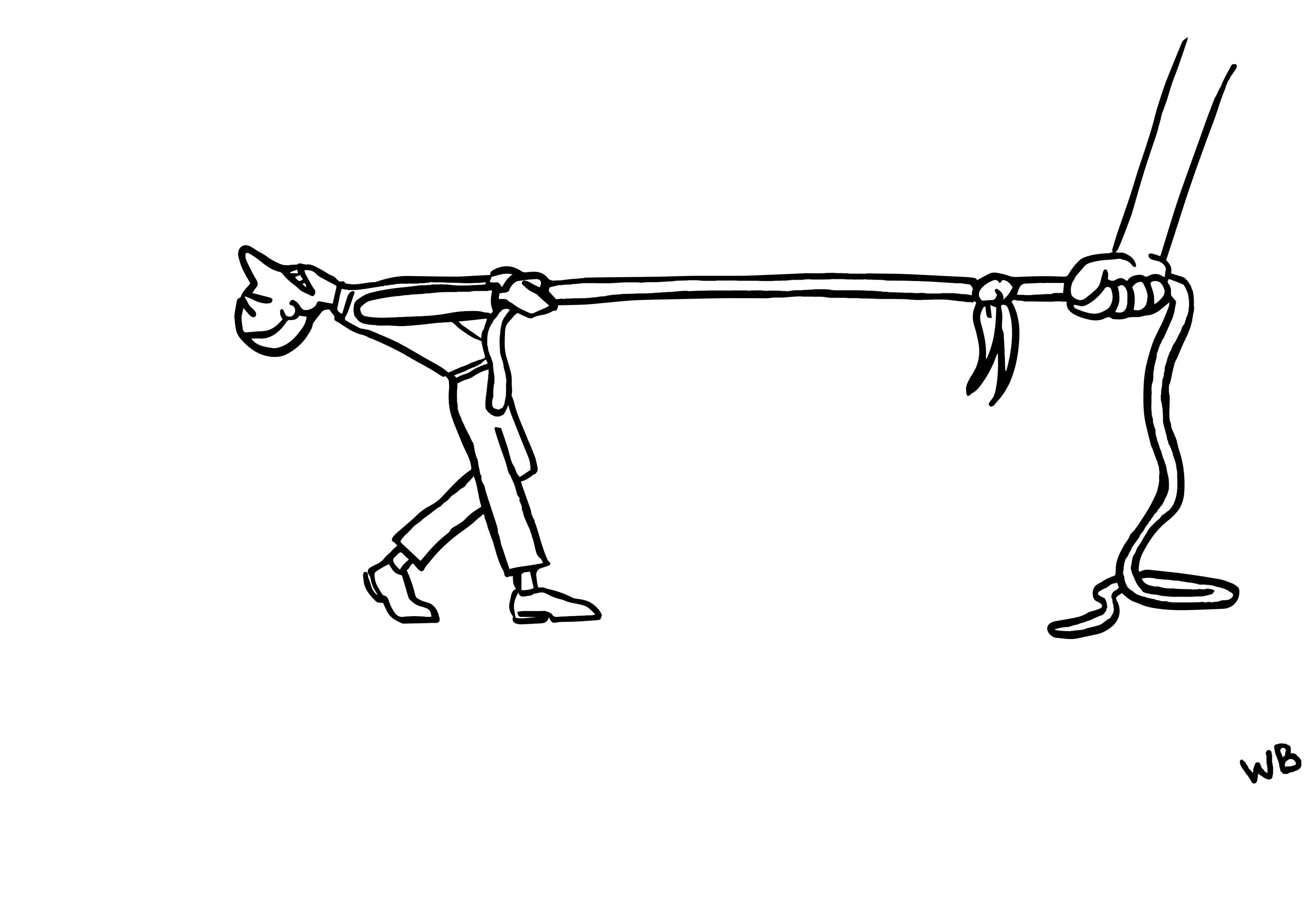
tug-o-war2There is an art to getting things done. The problem with logic is that it’s only half of the equation (and “half” is being generous). Logic can lead to a false sense of understanding. “This is the logical explanation,” we may say. There’s a logical choice, a logical path, a “right way.” But logical thinking often neglects to consider the other half of the equation—the emotional half. And emotions are a much more powerful force.

A considerable amount of what occurs in the world occurs because of emotion alone (without even the slightest consideration for reason). Forgetting about the emotional side can handicap us in the real world of “getting things done.” An idea may be the most logical, but that does not mean it will always triumph. The real world is not a meritocracy; just ask an economist.

In recent years, economists have recommended that NFL teams spend less resources trying to draft superstar athletes. Instead, they recommend trading top draft picks for multiple lower picks (spreading their risk of picking a top round dud). Despite showing that such changes would translate into more wins per season (about 1.5 more), team owners and general managers have generally ignored the advice. Why? Because there is more to life than logic. Teams are illogically overconfident that their picks are better than the competitions’ and owners enjoy having big name players on the roster. It’s not logical; it’s emotional. Historical precedent, personal ideologies, social allegiances—these are what constitute the illogical side of life, the emotional side. Economists work in the world of logical suggestions, but the real power lies in the hands of others.

My favorite definition of “power” is “the ability to get things done.” It avoids the negative connotations we have. There is no mention to coercion or corruption, no distinction between strong and weak, no manipulation tactics or financial sanctions. Power can just as easily relate to a healthy marriage as it can to a government regime. We are required to “get things done” everyday, and our ability to do so benefits not only us, but our friends, family, and colleagues. Power, therefore, is something we should wish on everyone.

To “empower” a person is to bestow them with the ability to help himself. We live in a world where emotions reign supreme. Events often happen on emotion alone (without logical consideration), but rarely the other way around. Logic, then, is the empowering piece of the puzzle; it is the prerequisite for significant improvement. But unlike the power of emotional whims, we cannot achieve with logic alone.

Good leadership, parenting, governance—they all require emotional intelligence, as well as critical thinking. This is the cornerstone underlying television shows like Hugh Laurie’s House M.D. and Benedict Cumberbatch’s Sherlock—the lone genius struggling in a world of social interaction and emotions, knowing these inevitabilities are as much a solution as they are a problem, a strength and a weakness. Destruction is easy with emotions alone, but building something meaningful requires both heart and mind.

Last week we discussed the frustrations of the workplace—the unspoken, sometimes unknowable rules (the emotional side). But more frustrating than office politics is actual politics. It can be ugly at times, but politics is the ultimate “art” of getting things done, where the complexities of social interactions far outweigh logical idealism or truth. People who vote with their heads struggle with this concept. They cannot understand voting with the heart. And that’s the classic downfall of a logic-heavy worldview: It leads to the dismissal of the human condition and the social/emotional sides to us all.

There’s an old journalism maxim, “if it bleeds, it leads,” which sums up the emotion-heavy side of society. Emotional hyperbole is popular; it sells news. We like stories about people (human interest pieces), and if there happens to be a murder involved, all the better! Humans are drawn to other humans, often in ways that defy reason. A string of bad relationship choices, the flock of rioting fans after a win—none of it makes logical sense, but it happens nonetheless. We must attempt to see the forest for the trees.

Understanding how society works, with all its human behavioral quirks, can buffer the logic problem. There is a scene in the 2000 historical epic, Gladiator, where Oliver Reed’s character—a wise, embattled ex-gladiator—gives some advice to the young warrior, Russell Crowe. He says to Crowe, “I was not the best because I killed quickly. I was the best because the crowd loved me.” Oliver Reed’s gladiator understood how the system actually worked, and that understanding (not his skill in the colosseum) is what set him apart. Logic is necessary to our success, but it must be balanced with the understanding, compassion, and social skills that human emotions provide. Such a balancing act is a real art form.

This is the second installment of a series titled “Too Smart  for Your Own Good.”

Standard
The Global Schoolhouse

Part 3 of 3: The Global Schoolhouse

[M]any critics of globalization make America the wicked villain in the tale. They portray the U.S. forcing Nike, McDonald’s and Baywatch down the throats of the unwilling world, shredding ancient cultures for the sake of empire and cash. But […] Multinational corporations are just that, multinational; they don’t represent American interests or American culture. Just as much as they changed the tastes and economies of other countries, they have tried to change the tastes and economy of the United States.

—Franklin Foer, How Soccer Explains the World

To begin Part 3, let’s review: The world is a schoolhouse; the global economy is its schoolyard; the game being played is economics/commerce; the schoolchildren who compete in this game are individual countries; their social cliques are based largely on history and finances; and multinational corporations? Well, they’re schoolchildren, too (but in a whole new way).

Multinational corporations are the younger siblings of our schoolhouse nations. They are smaller, have learned from the mistakes of their older siblings, and are more skilled at the schoolyard game of economics. Corporations share geographic, cultural, and historic parents with their older siblings (like Amazon with the United States), but that’s where the similarities end.

Just like younger students, multinationals have fewer obligations than their older counterparts—fewer classes to take, fewer school dances to attend, fewer extracurriculars. They have fewer distractions, in general. Instead, corporations mostly spend their time playing out on the schoolyard, focused on one thing—their game, how to efficiently make a profit.

This focus is what allows for a new paradigm, one of inclusion rather than exclusion. As we discussed in Part 2, nations have a tendency to favor their “in-group” clique. This leads to discrimination on the grounds of historical allegiances, rivalries, or economics.  Corporations, on the other hand, have different goals. They require outsiders (emerging markets), in order to continue growing. They want as many participants playing on the schoolyard as possible.

In the book The Better Angels of Our Nature: Why Violence Has Declined, Steven Pinker cites “commerce” as one of five reasons why we cooperate with one another instead of act aggressively. Multinationals understand this; it’s why they exist, why they are multi-national. It is in our economic best interest to cooperate globally. But commerce does more than give developing countries a chance to participate.

In November, The Wall Street Journal ran an article titled, “Netflix, Amazon Take Divergent Paths to Reach Indian Audience.” It was a quick read but highlighted this shift from traditional exclusion to emerging inclusion. The brief piece described Netflix’s cost-effective strategy to keep content production “in-house” at their California studio. The idea being that if the shows they make have multinational appeal, then Indian audiences, as well as other countries, will watch (in turn, saving the studio money). Conversely, Amazon has set up shop in Mumbai creating content in India with Indian actors and an Indian audience in mind.

The story of Amazon’s strategy in India is a hopeful one. It’s hopeful because in an attempt to grow, they are seeking a competitive advantage—to truly learn and understand their audience’s perspective. As we discussed in Part 1, all people want respect, and for the first time, those countries previously shut out of the established economies clique are starting to receive some.

If respecting the diversity and richness of the world’s cultures creates a competitive advantage for businesses, then there is hope for the billions of people within the developing world. Binge watching television may be a waste of time, but the Netflix-Amazon example shows a broader trend. Regardless of the business, the point is this: Emerging markets are finally being included in the game (if only as consumers to start).

Before we get carried away with the salvation of commerce, it’s prudent to acknowledge the elephant in the room—unbridled capitalism. The subject is a heavily debated one. Even the Pope has weighed in.  But rather than taking a Marxist view of inherent failure or Wall Street’s belief that “The Market is always right,” let’s assume for a moment that capitalism, like most things, has an equilibrium point.

Commerce cannot answer the world’s woes alone. While the inclusive strategy of multinational corporations may lead the charge, countries still need to decide for themselves that cooperation trumps aggression. It may feel ironic that a game that creates overpaid mega-CEOs could equalize the global divide, but perhaps it could.  Perhaps commerce can help create more global balance. There is an equilibrium point between corporations and nations that could help both to be successful—to learn, mature, and graduate from the global schoolhouse.

Standard
The Global Schoolhouse

Part 2 of 3: The Global Schoolhouse

Last week we set up the metaphor of a global schoolhouse with nations acting more or less in the same manner as schoolchildren. The G20 was used as our analogous “Classroom G,” divided socially along economic lines—developing countries on one side, developed on the other. Next week we will discuss another group in the global schoolhouse—multinational corporations—and how organizations that transcend geographic boundaries may be the answer to the developed-developing divide. But for now, let’s move from the classroom to the schoolyard and discuss the psychology of cliques—the psychology of global discrimination.

As a social clique, the “Western Powers” have played on the schoolyard relatively unopposed for the past 100 years. They generally make their own rules and exclude most newcomers. Sure, the West may have included nations like Japan or Korea, but only because of economic parity—common developed status. Financial prowess is the basis for in-group membership.

Sociologist would call this discrimination “in-group favoritism“—the concept that people positively view their own group’s members while looking upon outsiders with contempt. In-group favoritism, social identity, stereotyping, system justification—these are what fuel discrimination at all levels, and discrimination has been a part of the global schoolyard for centuries.

Developing countries have many obstacles on the road to equality, let alone dominance. Not only do they struggle to improve their skills of the game (economics), they are often closed off from making the rules or even playing in the first place. The popular kids on the schoolyard may justify this exclusion by citing past support or inclusion of Eastern countries like Japan, but ultimately they will continue to exclude. This justification is called “moral licensing.”

Moral licensing is defined loosely as, “being good frees us to be bad” or more specifically, “past good deeds can liberate individuals to engage in behaviors that are immoral, unethical, or otherwise problematic.” This principle is behind the justification for bad behavior occurring time and again throughout history. 

Bestselling author Malcolm Gladwell popularized moral licensing  in the first episode of his podcast Revisionist History. In the episode, Gladwell recounts the story of the 19th century British painter, Elizabeth Thompson, who sought entry into the most elite group of English artists of the era—the prestigious Royal Academythought to be made up of the forty most preeminent artists of the time. The problem was that the Acadmey had never had a woman member.

While the 19th century Royal Academy felt a moral obligation to allow the most talented artists into their club, they didn’t want a woman to be such a person. Elizabeth Thompson’s fellowship was put to a vote shortly after her painting The Roll Call (1874) rose to fame, and Thompson narrowly lost the majority required for induction. But almost—the fact that she had been seriously considered (proven by the narrow margin)—was close enough to morally justify nearly 50 more years of male-only membership.

Much like the 19th century Royal Academy was largely shaped by historical precedent and pseudo-supremacy, so too are the “Western Powers” of today. China and other emerging markets are said to be symbols of the global shift in power from established G7 economies to rapidly developing nations; however, like Elizabeth Thompson’s denial of acceptance, social barriers still loom over the future of developing countries.

While this seems like a bleak reality for the majority of the world’s nations, perhaps social norms play only a small part in the success of a rising nation. For there’s another role to be played in this schoolhouse, a role that transcends traditional schoolyard games. As a relative newcomer in history, multinational corporations may be the answer to global discrimination—a new paradigm to counter the old. And that’s where we will leave off until Part 3 next week.

Merritt, Anna C., Daniel A. Effron, and Benoît Monin. “Moral self‐licensing: When being good frees us to be bad.” Social and personality psychology compass 4.5 (2010): 344-357.

Standard
The Global Schoolhouse

Part 1 of 3: The Global Schoolhouse

Individual countries have always seemed like individual people to me. With their unique quirks, countries have all the idiosyncrasies of humans. They have distinct personalities, see themselves differently than outside observers, and judge their behavior based on intent while judging others based on action. Some countries are quiet, some loud, some big, some small, some fashionable, some plain (the comparisons continue).

To be clear, the collective “country” is distinct from the diverse collection of its citizens—the whole is different than the sum of its parts. That being said, countries are still like people, and what do all people want? Love and respect. Blatantly disrespect even the mousiest members of society and their blood will boil. Bullies are a product of overcompensation, self-image deficits, and lack of perceived respect. This universal need for respect helps explain much in global affairs.

As an obvious global bully, Russia simply wants the respect it feels it deserves. Seeing itself as a bastion of aerospace development, scientific research, military prowess, historical richness, Olympic champions, and cultural mainstays like art, ballet, and architecture, Russia may think, “We’re one of the greatest nations on earth. Why are we not given the relative level of respect that our status deserves? Let’s annex Crimea, then they’ll respect us!” Similar reasoning can be found in the seemingly antisocial behaviors of all sorts of global policies (not least, those of the United States). Self-centered, emotional, overly competitive, unaware, and simplistic—countries are not just like any people; they’re like school children.

There is one classroom that fits this metaphor well (although the teacher is nowhere to be found). The classroom is the G20—a group of the world’s twenty largest economies who get together to discuss global matters. Within “Classroom G,” as we’ll call it, there are all the features of a stereotypical schoolhouse. There are poorer kids, richer kids, extroverts, introverts, troublemakers, class clowns, slackers, bullies, brainiacs, and everyone in between. There are also social cliques (some even with labels).

Jocks, Preps, Nerds—these are unknown titles in Classroom G. Instead, the most well-known cliques go by other names (NATO, BRICS, G7, G4, and so on), but the most “popular” group is known historically as The Allies. The paradigm of World War I and II has continued for over 100 years and has evolved to roughly include an alliance between the world’s largest economies—the popular kids of the class (although, they are often not very popular with the rest of the students).

The in-group’s membership has changed many times throughout the decades. Where countries like Russia, China, Japan and Germany were once historical outsiders, they now have a seat at the table (but not officially in certain circles—the Group Seven or Permanent Five, for example).

There is an oversimplified explanation for this elite group of students: The trend-setting  group in Classroom G is a clique of develop-ed countries on the inside and develop-ing countries on the outside (with a few choice exceptions). Economics supersedes historical alliance. And as trite and ill-defined as the terms developing and developed may be, they serve as the arbitrary (but necessary) boundary in which our classroom creates a status quo.

It is important to point out, however, that Classroom G countries are not teachers, but peers. Their authority is social in nature, not hierarchical. Therefore, we could hypothesize that international relationships conform to the same social and psychologic theories that humans do…  But more on that next week.

Standard