Uncategorized

The Cliff of Care

too muchImportance is the worst thing to put on art, comedy—creativity of any kind. […] If you think this is important, you’re screwed before you write the first word.

—Jerry Seinfeld, Comedians In Cars Getting Coffee with Lewis Black

What is the difference between caring too much and not enough? Sometimes it’s just one last straw—one final incident that pushes us over the edge. We see this at our workplaces, contrasting an excited intern with the embattled veteran clocking in and out like a robot. We see it with new parents who trade fashion for durability. And we see it in politics when the news creates such a piercing noise that we simply go deaf to the din.

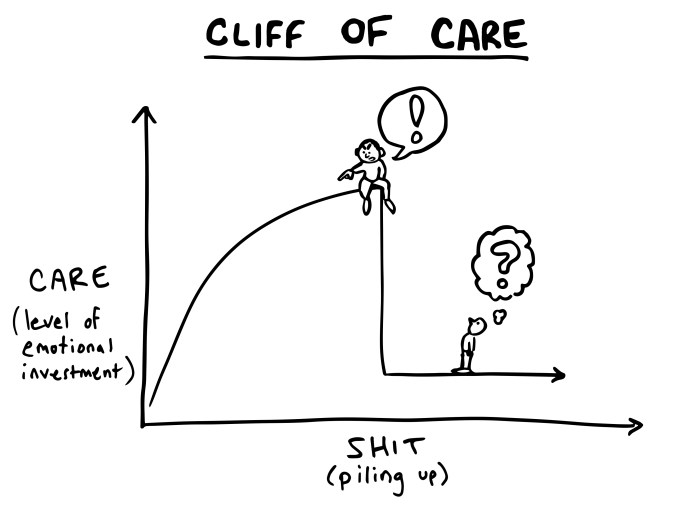
Like eating or drinking too much, our care has a breaking point. A gluttonous night out can force our stomach from too full to completely empty in an instant, and it is this momentary purge that exemplifies the Cliff of Care. With so many names—outrage fatigue, clarity, burnout, calm, apathy, patience—it can be difficult to know whether the valley beyond the cliff is a safe place to be. As with any journey, it depends on how we got there and our attitude along the way.

Once we reach the cliff’s edge, we can either walk off gracefully, landing softly on the ground below, or get pushed, kicking and screaming, breaking bones on the way down. This is the difference between coming to peace with our situation or becoming apathetic in our resentment. The graceful among us land on their feet through the power of perspective. These are the people who after battling illness, divorce, violence, bankruptcy, discrimination, and many other hardships, still find the positive in each challenge, putting them into perspective. They are calm and kind despite every reason not to be. And they serve as inspiration to “get over” whatever small annoyances we face in life.

Unfortunately, the less gracious cliff jumpers—the ones who bitterly or hopelessly give up the will to care—also exist. Fortunately, the Cliff of Care is not a standalone phenomenon. We may tumble off the cliff and become apathetic to the politics of our world but safely detached at work, no longer wrapping our self-worth in what our boss thinks. This is where awareness can be helpful. Just by knowing about the difference between being on the cliff and being in the valley can help us safely navigate our way.

Detaching emotionally is not something we can will ourselves to do (at least, not immediately). Stepping off the cliff allows us to leave behind our emotional baggage, but first it requires a gradual climb of frustration. This is why telling someone they need to just “get over it” rarely works. Seeing the cliff for what it is can make us come across as callous or cold-hearted when dealing with those who have not yet moved on. Brushing off their emotional concerns as unimportant is seen as dismissive. Rather than pushing them off the cliff to a painful, bitter landing, we must try to remember what it was like to be atop the cliff, empathize, and help guide them down safely.

Conversely, when we’re stranded on the peak of care, pulling our hair out, and wondering why no one else gives a shit, it is difficult to see our position for what it is. We don’t have the perspective. Holding on to what feels important can be blinding. Whether it’s the cleanliness of the kitchen, quarterly sales at work, or death of a loved one, not everyone is going to understand our level of care. And while intense care can motivate us to act, we shouldn’t expect others to follow. When we find ourselves in isolation in a sea of seeming apathy, it may be time for self-reflection. It is immodest to think that we are the only sane people in a world full of crazies.
cliff of care_graph

Standard
Uncategorized

Rock-Paper-Scissors: Body, Heart, Mind?

heart-beats-bodyI’m hurt, no doubt about it. I’m not worried about the pain. I don’t care about the pain, don’t even feel it. I’m not even worried about hurting myself anymore than I already have—no, I’m worried about hurting the team.

—Ray Lewis, former NFL linebacker, I Feel Like Going On: Life, Game, and Glory

Rock-paper-scissors is a hand-gesture game played to settle childish disputes (or so I thought until three days ago). As it turns out, the millennia-old game helps explain a lot in the world. Rock-Paper-Scissors is surprisingly well represented in academic literaturealternative male-mating strategies in lizards, antibiotic-mediated antagonism, protecting public goods from the tragedy of the commons, and that’s just getting started. The New York Times even has an online version of the game to play a computer, which pulls from over 200,000 previous rounds (p.s. It will probably beat you). But why is this simple game so ubiquitous?

We often think of win-lose games in terms of two teams battling head to head; however, nature (including human nature) rarely works in such a direct way. An action in one area often has unintended consequences in another. Rock-Paper-Scissors is a game of checks and balances. And with only three variables, it is the simplest version. If the goal is, for example, to reduce the amount of Scissors in the world, then Rock should be thrown time and time again. Throw a lot of Rocks and we’ll get rid of the Scissors, but with less Scissors, more Papers survive—leading to trouble for all those Rocks we threw. This is the basic premise for what scholars call “circular dominance,” otherwise known as Rock-Paper-Scissor dynamics. And this concept helps explain much of the human experience.

While we all have different personal motivations, there’s a universal internal tug-o-war—a motivation triad—that can either get in the way of or optimize our goals. The balance between our physiologic needs (Body), our emotions/feelings (Heart), and our logical reasoning and processing (Mind) are what create the diverse range of behavior we see everyday. Being human may not be simple, but let’s take a closer look at a simple game to see if we can improve our performance:

  1. Body—like Rock, it’s solid, dependable, strong, and can be used like a weapon.
  2. Heart—like Paper, it can be written on, read, shared, crumpled, or torn.
  3. Mind—like Scissors, it’s sharp, precise, specialized, but can be dangerous.

Heart beats Body. What motivates a person to push through the pain, in order to run one more lap in practice? What about staying awake all night to finish a project with an impending deadline? What possesses a person tstart a fight despite obvious physical danger? Or to charge into enemy territory, bayonets at the ready? Human emotions can push our bodies beyond comfort. They transcend our normal physiology, creating adrenaline rushes to push through the pain, get passed the tired, or forget the hunger. Depending on the circumstance, this can be an advantage or disadvantage. Professional athletes, like Ray Lewis (quoted above), use their “pumped up” emotional state to achieve a high level of physical performance. But there are instances when emotions can put our bodies in jeopardy—like fighting for pride, love, or anger. And we can all relate to those sleepless nights, tossing and turning over emotional stresses at work, arguments with a significant other, or any number of other feelings.

Mind beats Heart. When we’re up at night, working ourselves up into a sleepless, emotional frenzy, only a calm mind can put our anxiety into perspective. Emotions can cloud our understanding of the big picture, making us feel like the emotion we are experiencing at that moment is the most important thing in the world. By adding context and perspective, our Minds can neutralize our irrational side. This concept of primitive and evolved brain is represented in different ways throughout the literature; the  Heart/Mind dichotomy goes by different names—Think vs. Blink, System 2 vs. System 1, Analytical vs. Intuitive—but essentially it’s this: We all have an immediate reaction brain (Heart) that is fueled by basic emotional needs (ex. love and respect), and when we feel those needs are in conflict or under attack, we tend to react. Only our level-headed Mind can defeat the negative side of emotions.

Body beats Mind. Obviously, the Mind does not always beat the Heart, but perhaps it’s because the Mind has already been defeated. Graduate education is rife with unhealthy study behavior—caffeine binges, all-nighters, a diet consisting of power bars and skittles. But the lie of this type of behavior is thinking that the Body doesn’t matter—that if a student can cram for one more hour at 3 A.M. then he will perform better on an exam. There is an eventual breaking point, a point where our minds starts to get cloudy, our work starts to slip, we begin to forget things, and have trouble sayings words. That point is when the body is forcing a shutdown. Being chronically fatigued, having insufficient nutrients in one’s diet, even physiologic sexual frustration can all play a role in how clearly our thinking is. Being deprived of physiological needs wears down our willpower and pushes us from a mind-deciding person to an emotion-deciding one. And taken to the extreme—extreme hunger, extreme thirst, extreme sickness—we become physiological-driven creatures.

It is helpful to recognize the interrelationship between the three parts of ourselves—Body, Heart, Mind. Knowing how they interact, we can buffer known problems. For example, after starting a business, launching a product, or quitting a job, there are a lot of unknowns; the task at hand has just begun. That reality can be an emotional time, but it’s a known emotional time. To get through challenges like the stress of not yet finding a new job, we require clear thinking about the big picture, and doing so requires our bodies to be well fed, well rested, and somewhat active. And that’s just one example.

Body-Heart-Mind dynamics are as important for interpersonal relationships as they are for self-improvement. Often, we are not able to see our crazy while we’re in the crazy. That’s why it’s important to recognize it in others—friends, family, spouse, colleagues, etc. Reacting emotionally when faced with someone that’s emotional is rarely the right course of action—”Don’t fight fire with fire.” Instead, helping an emotional friend see the rationale side of a situation, a different perspective, and adding some context to an emotional and confusing time is what will help. Knowing ourselves and others—having an awareness of what’s going on—that’s the first step. What we do with that information is up to us.

Semmann, Dirk, Hans-Jürgen Krambeck, and Manfred Milinski. “Volunteering leads to rock–paper–scissors dynamics in a public goods game.” Nature425.6956 (2003): 390-393. (Source)

Standard
Too Smart for Your Own Good

Beliefs (or lack thereof)

fairy-stareWhat is religion? It’s community, history, cultural identity; it’s a way to make sense of the world. Some of us use religion as our primary source of answers; others use mysticism; others: science; and still others use a combination of methods. This is not an argument for one way over the others, but rather a look at beliefs through several different lenses:
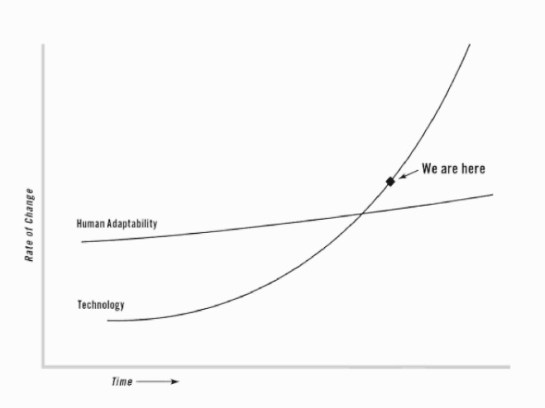
We all try to make sense of the world. Our methods may differ, but we are all seeking to understand the same universe:

People find themselves in a mysterious and mysteriously ordered universe. They find themselves equipped with sort of intense moral instincts.  They have religious experiences, and they develop systems that explain those.

—Ross Douthat, author of Bad Religionspeaking on Real Time with Bill Maher (2012)

Religion plays a comforting role for some people:

[P]eople who lose personal control take comfort in religion, because it suggests to them that the world is under God’s control and, therefore, predictable and nonrandom.

—Zuckerman et al., “The Relation Between Intelligence and Religiosity” (2013)

But the comfort of belief is not confined to religious doctrine:

Human beings are believing animals, period. […] Even secular liberals have their [beliefs…] What is the idea of universal human rights if not a metaphysical principle? Can you find universal human rights under a microscope? Is it in the laws of physics?”

—Ross Douthat, author of Bad Religion, speaking on Real Time with Bill Maher (2012)

It is becoming more difficult to understand a world defined by modern technology:

The modern technologies of the day are a bit of a black box for the average person. […] the average person I meet on the street doesn’t feel any kind of connection to the technologies that are defining their world and shaping the fabric of society.

—Steve Jurveston, billionaire tech investor, “Acclerating Rich-Poor Gap,” Solve for X (2013)

But humans are resilient creatures: Make the world incomprehensible, and they will find a way to comprehend it:

The explosion in communication technologies over the past decades has re-oriented society and put more psychological strain on us all to find our identities and meaning. For some people, the way to ease this strain is to actually reject complexity  and ambiguity for absolutist beliefs and traditional ideals.

—Mark Manson, author, “The Rise of Fundamentalist Belief” (2013)

While we are getting better at adapting to the ever-changing world…:

“The rate at which we can adapt is increasing,” said Teller. “A thousand years ago, it probably would have taken two or three generations to adapt to something new.” By 1900, the time it took to adapt got down to one generation. “We might be so adaptable now,” said Teller, “that it only takes ten to fifteen years to get used to something new.”

—Thomas Friedman quoting Astro Teller, CEO of Google’s X Research & Development Laboratory

…the world is changing at an ever-increasing rate:

An analysis of the history of technology shows that technological change is exponential, contrary to the common-sense “intuitive linear” view. So we won’t experience 100 years of progress in the 21st century — it will be more like 20,000 years of progress (at today’s rate).

—Ray Kurzwell, computer scientist,“The Law of Accelerating Returns” (2001)

Technology may soon make everyone feel as if they’ve lost control:

“If the technology platform for society can now turn over in five to seven years, but it takes ten to fifteen years to adapt to it,” Teller explained, “we will all feel out of control, because we can’t adapt to the world as fast as its changing.
—Astro Teller, CEO of Google X, quoted in Thank You for Being Late (2016)
image

And while some people think the world is still divided into those who “understand” and those who don’t…:

[Disconnection from technology is] a different kind of estrangement. It’s almost like a cognitive separation—those who know and those who don’t know about the world they live in.

—Steve Jurveston, billionaire tech investor, “Acclerating Rich-Poor Gap,” Solve for X (2013)

…technological advancement will eventually humble even our brightest minds:

“None of us have the capacity to deeply comprehend more than one of these fields [genomic cloning, medical robotics, artificial intelligence]—the sum of human knowledge has far outstripped any individual’s capacity to learn—and even experts in these fields can’t predict what will happen in the next decade or century.”

—Astro Teller, CEO of Google X, quoted in Thank You for Being Late (2016)

For, at the end of the day, we are all humans (no matter how intelligent). And that is the thesis of this entire “Too Smart for Your Own Good” series:

You are never too smart to be humble.

Intelligence does not make a person immune to faulty logicinsensitivity, poor timing, or technological change. There are biological limitations to being human. However we choose to make sense of the world—whatever strategies for life we employ—we are making a personal choice. So remember: “Judge not, lest ye be judged.”


Additional Reading:

Urban, Tim. “Religion for the Nonreligious.” waitbutwhy.com (2014): (Source)

Sharov, Alexei A., and Richard Gordon. “Life before earth.” arXiv preprint arXiv:1304.3381 (2013). (Source) (Summary)

Zuckerman, Miron, Jordan Silberman, and Judith A. Hall. “The Relation Between Intelligence and Religiosity: A meta-analysis and some proposed explanations.” Personality and Social Psychology Review 17.4 (2013): 325-354. (Source)

This is the fifth installment of a series titled “Too Smart  for Your Own Good.

Standard
Too Smart for Your Own Good

The Benefits of Doubt

big-head

This is a story of two brainiacs—both pioneers in their chosen fields, both knowingly intelligent, and both recipients of the Nobel Prize. Despite their similarities, the stories of William Shockley—and his eventual demise—and Daniel Kahneman’s ultimate redemption differ in each genius’s relationship with self-doubt. While doubt is often cast as the villain of our lives, this is a different tale, one where doubt is the protagonist, the saving grace. This is a story of two men whose success and failure hinged on the benefits of doubt.

William Shockley grew up in California during the 1920s, receiving a B.S. from California Institute of Technology in 1932. Quantum physics was still a fresh discovery, and Shockley reportedly, “absorbed most of it with astonishing ease.” In 1936, he earned his Ph.D. from M.I.T. and began his innovative career at Bell Laboratories, one of the most prolific R&D enterprises in the world. As a research director at Bell, Shockley helped invent the transistor (as in “transistor radio”), for which he received the Nobel Prize in Physics in 1956—an achievement that would lead to his eventual undoing.

That same year, Shockley moved back to Mountain View, California to start Shockley Semiconductor Laboratory, the first technology company in what would become Silicon Valley. As a researcher and a manager, William Shockley was brilliant, innovative, but domineering. His arrogance at Shockley Labs was a point of contention among the employees and a problem that would only be exacerbated after the Nobel Prize. Winning the prize seemed to eradicate any residual self-doubt left from his youth. Shockley became deaf to outside opinion, blind to reason, and unforgivingly egotistical. In 1957, less than a year after becoming a Nobel Laureate, eight of Shockley’s best and brightest left the company to form Fairchild Semiconductor.

The Shockley schism was in large part due to William Shockley’s unwillingness to continue research into silicon-based semiconductors despite his employees’ belief that silicon would be the future. His hubris would be his end, as Shockley Labs never recovered from missing the silicon boom. The cohort who left would later create numerous technology firms in Silicon Valley (including the tech giant, Intel), giving birth to what has become one of the most innovative regions in the world.

William Shockley, himself, faded into obscurity, estranged from his children, his reputation tarnished after years of public touting of eugenics. Along with Henry Ford, Pablo Picasso, Albert Einstein, and Mahatma Gandhi, Time Magazine would name William Shockley as one of the “100 Most Important People of the 20th Century.” Yet he died bitter and disgraced in 1989, still headstrong, self-doubt still absent from his life. For Shockley, arrogance and intellect seemed to be inextricably linked; however, such a fate is not inevitable.

Daniel Kahneman’s story is different. It’s one where self-aware intellect meets a healthy dose of self-doubt. Born in 1936, Kahneman grew up a Jew in France during the Nazi occupation. His family was displaced several times and his experiences with Nazis would show him firsthand the complexities and peculiarities of the human mind—a foreshadowing of his illustrious career in psychology.

As an adolescent after World War II, Kahneman moved to Palestine where in eighth-grade he finally found like-minded friends. Acknowledging both his intellect and its dangers, he writes, “It was good for me not be exceptional anymore.” While Kahneman knew he was smart, he always saw his deficits (and sometimes to a fault). As Michael Lewis, author of Moneyball and The Undoing Project, puts it, “Everything [Daniel Kahneman] thinks is interesting. He just doesn’t believe it.” And this self-doubt would lead directly to his success.

After getting degrees from Hebrew University and U.C. Berkley, Kahneman’s work in psychology would take off after his first collaboration with Amos Tversky. Between 1971 and 1981, Tversky and Kahneman would publish five journal articles that would be cited over 1,000 times. Their work in cognitive biases—largely fueled by the ability to doubt their own minds—has been instrumental in upending the long-standing belief that humans are purely rational creatures.

In 2002, Kahneman was awarded the Nobel Prize in Economics for showing that even the brightest among us make mental mistakes everyday—prospect theory, cognitive biases and heuristics. Like William Shockley, winning the Nobel Prize would be a turning point in Kahneman’s life; unlike Shockley, the prize made Kahneman better not worse. Michael Lewis again comments, “[T]he person who we know post-Nobel Prize is entirely different from the person who got the Nobel Prize […] he is much less gloomy, much less consumed with doubts.” In a stroke of irony, it would take what is arguably the most prestigious award in the world to finally provide Kahneman with the validation that his thoughts on doubt are worthwhile.

Kahneman’s career has been largely focused on the benefits of doubt—the idea that humans may be mistaken in our confidence and intuition, and need to question our assuredness. While his legacy is still to be seen, Kahneman’s work may prove to change how humans think about thinking forever. His impact may even put him on Time’s list of “100 Most Important People of the 21st Century.”

The stories of Shockley and Kahneman serve as both a warning and a call to action. Doubt should not be seen as a curse, but rather a necessity—a blessing, even. It is when we are not in doubt that we should take notice. Arrogance at any level can blind us. We don’t have to be a savant to be egotistical or have a “big head” (yet the smartest among us are often guilty of this). Only through our doubts can we expect to learn from others, question our assumptions, and, ultimately, be successful long-term. As soon as we stop doubting, stop questioning, we stop growing.

This is the fourth installment of a series titled “Too Smart  for Your Own Good.”

Standard
Too Smart for Your Own Good

Ignorance Is Bliss-ish

ignorance-is-blissLife is like pouring concrete. (Bear with me here.) The world provides an endless supply of mystery—raw concrete mix—and over time this concrete pours out into our lives, moving from the unknown (concrete mixer) to the known (exposed, wet concrete). We learn new things, have new experiences, and make new discoveries. In this process, we shape our new knowledge into a unique worldview—a concrete foundation. And just like concrete, our worldviews harden over time.
Children are exposed to so much newness that the concrete flows out like a hole in a dam. They mold the onslaught of new information as well as they can, trying to make room for the next layers. As we get older, however, the concrete that once flowed freely begins to slow. For adults, finding new knowledge comes with a cost—our time and energy. Building upon our worldview foundation requires actively seeking the unknown—journeying to the land of new information at the risk (or benefit) of altering our concrete structure.

There are only two ways to change a concrete worldview: Addition or subtraction; either we (a.) add more concrete—more knowledge—that can be molded around the existing structure, or (b.) we take a jack-hammer to our concrete edifice in an attempt to reconfigure its appearance. The former option is more delicate, incremental, and self-directed. The latter is less controlled, more dramatic, and often occurs by outside influence. Experiences that fly in the face of our worldview are processed in different ways by different people. And while the truth has a way of eroding our most egregious misconceptions, some people’s structures are more protected than others.

The world is essentially made up of three types of people: 1. Never Quitters, 2. Bitter Quitters, and 3. Happy Quitters. This is to say that there are people who persist, people who give up in discouragement, and people who are content watching rather than participating. Let’s examine each of these three groups using a totally nonscientific nor rigorous methodology—the clichés that they most represent.

Never Quitters are the persistent, “lifelong learners” who continually pour and shape concrete onto their worldview foundation. They are so named for the motivational cliché, “Never give up.” Bitter Quitters are ex-Never Quitters who, in their search of the unknown, stumbled upon an undesirable reality and decided to go no further. This group is summarized by the phrase, “Better the devil you know, than the devil you don’t.” And the final group—the Happy Quitters—may know of a world beyond their bubble, but choose not to explore it, because… well… why would they? They’re content with their lives. Theirs is a comfortable bubble, like being tucked under warm, cozy blankets in a frigid bedroom. And for this group, “Ignorance is bliss.

In a world where, as YaleGlobal Online reports, “the gap between job requirements and available skills is widening,” and technological advancement is outpacing society’s ability to keep up, it seems “obvious” to the Never Quitters that continual learning is imperative. To a Never Quitter, bowing out of the world of learning seems like an admission of defeat. “Now, more than ever, is a time for continual learning, up-skilling, and growing to stay relevant in an ever-changing landscape,” the Never Quitter may say. But they are missing a crucial point.

There is value in the known, the familiar, and the comfortable (especially if such a worldview has a solid foundation). The known allows for a state of low-anxiety and contentment. Also, we all become either a Bitter or Happy Quitter eventually. The 97-year-old lifelong learner may decide that he’s perfectly content not understanding how Twitter works. It’s a common mistake of the “Too Smart for Your Own Good” cohort to think that everyone would benefit from journeying down the Path of the Mental Unknown. They fail to acknowledge the personal benefits of a comfortable, insulated worldview, which Quitters regularly enjoy. In order to coexist, people are not required to agree on how best to live life, but we do need to understand one another’s perspective. How each of us shapes the concrete that life provides is completely up to us.concrete-life

This is the third installment of a series titled “Too Smart  for Your Own Good.”


For more information on lifelong learners in America, consider reading the following report: Pew Research Center, March, 2016, “Lifelong Learning and Technology.” (Source)

Standard